ChatGPT Ads vs. Google Ads: Where should your hotel invest?
Marketing 01/10/2026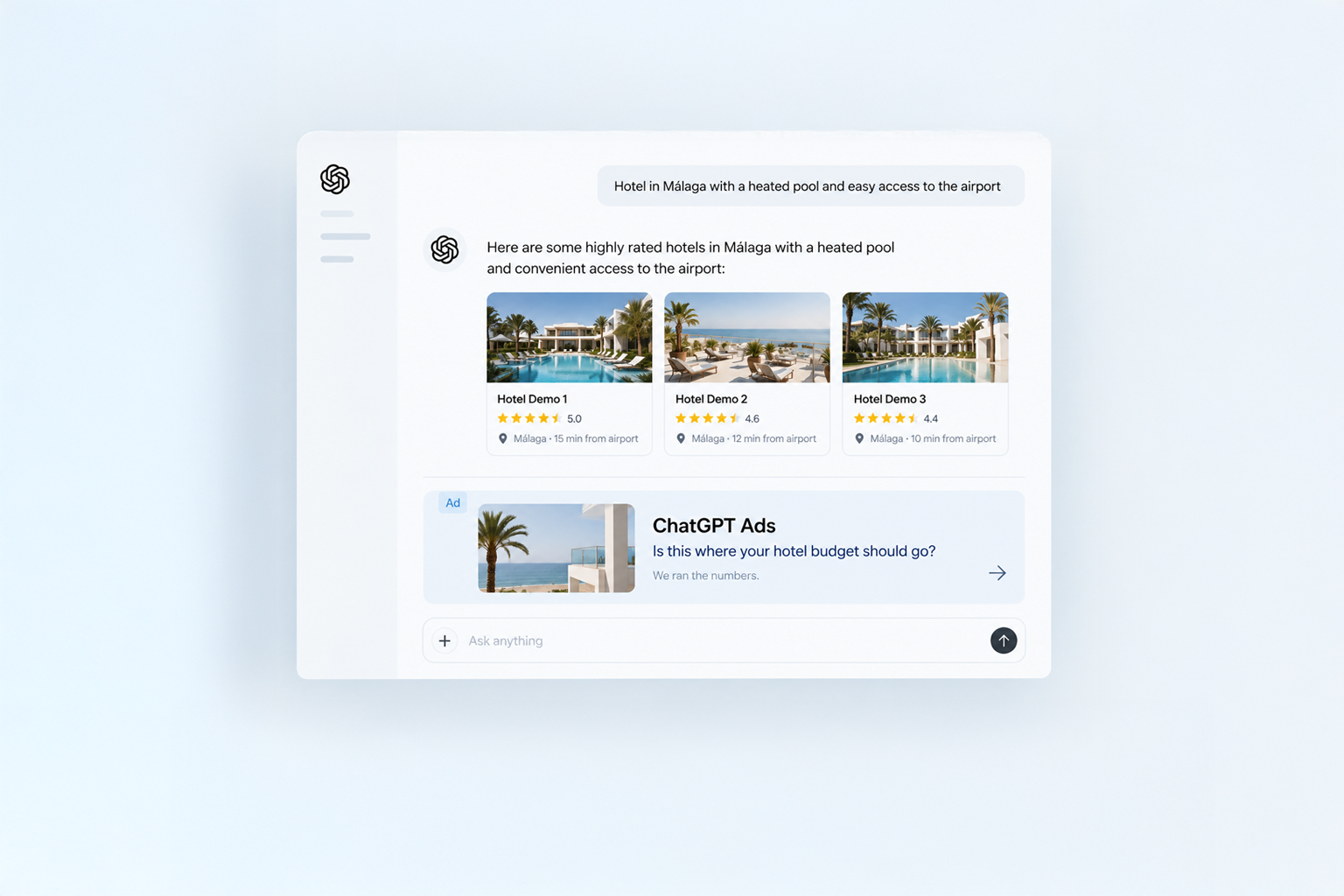
Every time a new acquisition channel emerges, the same temptation arises: invest before knowing how much volume it can actually deliver and at what cost. That is happening with ChatGPT. So before shifting budget, it is worth understanding what kind of demand it really generates and what tools it makes available to hotels.
At Paraty Tech, we ran the numbers. We analyzed the Spanish hotel market in terms of demand, cost, and profitability, using data from our portfolio across Google Ads, Meta, and metasearch as a benchmark. The conclusion fits in one line: advertising investment still belongs in Google, while visibility in generative AI should be built now, without putting media budget behind it.
The opportunity, therefore, is not to wait. It is to start working today on the organic visibility that allows your hotel to appear in AI-generated answers.
In this article
A traveler can ask ChatGPT for something Google has traditionally handled with more difficulty: “hotel in Malaga with a heated pool, accessible facilities, and less than 20 minutes from the airport.” The response does not simply return links. It interprets a complex intent, filters options, and can present a selection of properties. It also offers something unusual: a recommendation layer where a hotel can be mentioned without going through an OTA’s commercial filter.
In addition, a user arriving from a conversational assistant has often gone through a longer research process, with the hotel already shortlisted and many of their objections resolved. That is potentially qualified traffic. But this visibility cannot be bought. It comes when ChatGPT recommends a hotel in its answer, while the ad occupies a separate space. And when we move from potential to volume, the picture changes considerably.
Google receives around 35 million monthly accommodation-related searches in Spain. ChatGPT receives around 1.6 million prompts. But comparing these figures as they stand can lead to misleading conclusions because a conversational prompt and a Google search do not have the same intent. What matters is demand with commercial intent. On Google, we are talking about around 21 million searches (60% of the total), compared with around 256,000 ChatGPT prompts (16%).
ChatGPT represents just 1.2% of Spain’s commercial hotel demand. Put another way, Google generates around 82 times more demand with purchase intent.
We should be transparent about this figure. OpenAI does not publish volume data, so ChatGPT figures are estimates based on public sources. That is why we cross-checked them. Using Ahrefs’ methodology, which puts global ChatGPT volume at around 12% of Google’s, the equivalent share would rise to 3.2%. More generous, yes. Enough to change the scale of the gap, no.
The picture does not change outside Spain either. Across the six markets analyzed (Spain, Portugal, France, the United Kingdom, the United States, and Mexico), Google accounts for at least 86% of search activity. And in none of them does ChatGPT’s advertising product yet offer the hotel-specific targeting or volume an account needs.
Let’s think about the guest journey from the beginning. First, the traveler decides where they want to go (inspiration: “where should I go on vacation in October?”). Then, they look for accommodations that fit their needs (consideration: “charming hotels in Cadiz for a couple”). Next, they compare reviews, prices, and availability (decision: “Hotel X reviews, price, availability”). Finally, they book (“Book Hotel X, 3 nights, 2 adults”).
ChatGPT is particularly strong at the beginning of that journey, when dates, destination, and budget are not yet set. Google dominates the final stage, precisely where the booking decision is made and paid for. And those final stages are where advertising makes the most sense for a hotel. Today, ChatGPT does not yet offer an ad format with destination and date targeting or rate integration that would allow hotels to compete at this stage of the decision-making process.
To see this in practice, we ran a simple query: “hotels in Tenerife.” At the top, we saw the answer and a hotel module with properties, ratings, and prices. At the bottom, at the end of the conversation, there was a single advertising slot. And who occupied it? A travel insurance company.
That scene highlights three problems at once:
The real opportunity for hotel visibility lies in the answer and the results module. Neither can be bought. They are earned through content, structured data, and reputation. A channel that acts before the point of purchase has discovery value, but that does not mean the same space is currently an efficient paid acquisition channel for a hotel.
OpenAI recommends starting with a maximum bid of $3 to $5 per click (€2.75–€4.60) in a relevance-weighted second-price auction, meaning the amount paid is below the bid. Our estimate puts effective CPC between €1.50 and €3.50, with €2.20 as the reference point. Across the three scenarios we modeled (€1.50 to €3.10), a ChatGPT click costs between 4 and 9 times the average cost of a branded campaign, putting it at the upper end of generic Search, which is already the least profitable channel in the mix.
An expensive click can make sense if it converts significantly better. So we ran the full calculation for a typical hotel: €130 ADR, 2.3-night average stay, and €299 average booking value. And we deliberately gave ChatGPT generous conversion rates, precisely because conversational traffic may arrive more pre-qualified. In the central scenario, we even assume a higher conversion rate than generic Search.
[Table preserved with translated labels] The majority of hotel businesses need a ROAS of between 6x and 8x to be profitable once management costs are included. Even with those generous conversion rates, ChatGPT comes in at 3.0x in the central scenario and 1.4x in the pessimistic scenario. Even in the optimistic scenario (6.0x), it barely reaches the lower end of that threshold, well below metasearch (13.6x) or branded Search (51.3x).
The question, therefore, is not whether the traffic is high quality. It is whether that quality justifies the cost of acquiring it.
There is a second bill that does not appear in the CPC. The money allocated to testing a new channel has to come from somewhere. According to our calculations, a test cycle of around €4,000 is needed to get a reliable read on return. At a rate of €65 per day, that would mean roughly two months of campaigning.
The problem? That budget is already working and generating returns in other channels.
[Investment cards preserved with translated labels] If the €4,000 comes from generic Search, ChatGPT would need to reach at least 3.7x for the budget shift to be neutral. If it comes from metasearch, it would need to reach 13.6x. Today, we do not have observed hotel return data from ChatGPT that would allow us to say it reaches even the lower end of that range.
This is compounded by barriers that no increase in budget can solve:
These are product barriers, not budget barriers.
This is probably one of the key takeaways from the analysis. The fact that ChatGPT is not yet the place to move budget does not mean we should ignore the shift in user behavior it represents.
Travelers are moving away from isolated keywords and starting to describe what they want in a complete sentence: “hotel in Cadiz with a heated pool that allows dogs for the December holiday weekend.” That conversational search can already be captured on Google. And that is where AI Max comes in.
It is not a standalone campaign type, but a configuration within existing Search campaigns. It expands reach to longer, conversational queries without giving up what supports performance: conversion measurement, search terms reporting, brand controls, location targeting, and management at scale. According to our analysis, its CPC ranges from €0.30 to €1.20, compared with the €1.50–€3.50 estimated for ChatGPT.
The difference is not that one understands natural language and the other does not. Both respond to the same shift in user behavior. The difference lies in everything that happens afterward: buying, measuring, optimizing, and scaling.
That said, AI Max is not a set-it-and-forget-it button. It requires weekly reviews of the search terms report, monitoring branded search share to avoid cannibalization, and a minimum volume of conversions for the system to learn. When Google activates AI Mode as the default search experience, this configuration will no longer be optional. Activating it now means getting the learning curve out of the way.
So, what should hotels do with ChatGPT? Do not pay to appear. Work to appear.
Our current recommendation is to allocate 0% of media budget to generative AI and keep investing in channels that already offer volume, measurement, and scalability. But 0% of budget does not mean 0% of attention. Quite the opposite. There are three areas hotels should start working on now:
The opportunity generative AI represents for a hotel is not only about getting a click. It is about becoming part of the answer that helps a traveler make a decision.
The landscape may change, and it probably will. That is why this analysis is not intended to close the door, but to establish objective conditions for reviewing the investment every quarter.
[Review table preserved with translated labels] Today, only measurement meets the criteria. The conversion tag and API are already available. The others still need to evolve. And this is the important part. There is no need to wait a year to look again. In a market moving at this speed, the decision needs to be reviewed as often as the product changes.
Generative AI matters, a lot, at the point when travelers dream and compare. But today it represents 1.2% of commercial demand, its clicks cost 4 to 9 times more than those of a branded campaign and, according to the scenarios analyzed, its estimated return remains below a hotel’s profitability threshold. Paying to appear there means paying a premium to arrive late to a conversation that has already been shaped higher up the funnel.
The smart move is twofold. Invest in conversational search where it can already be measured and scaled, and earn the recommendation of AI assistants through content, data, and reputation. When the channel matures, we will know in time. Because we will be measuring it.
At Paraty Tech, we ran the numbers. We analyzed the Spanish hotel market in terms of demand, cost, and profitability, using data from our portfolio across Google Ads, Meta, and metasearch as a benchmark. The conclusion fits in one line: advertising investment still belongs in Google, while visibility in generative AI should be built now, without putting media budget behind it.
The opportunity, therefore, is not to wait. It is to start working today on the organic visibility that allows your hotel to appear in AI-generated answers.
In this article
- AI is already influencing hotel choices. But how much demand does it actually drive?
- The recommendation comes first. The ad comes later
- An expensive click needs more than intent
- Opportunity cost matters too
- Conversational search can already be leveraged on Google
- Before investing, there is work to be done
- The decision should be reviewed, not considered final
- You earn ChatGPT. You buy Google.
AI is already influencing hotel choices. But how much demand does it actually drive?
A traveler can ask ChatGPT for something Google has traditionally handled with more difficulty: “hotel in Malaga with a heated pool, accessible facilities, and less than 20 minutes from the airport.” The response does not simply return links. It interprets a complex intent, filters options, and can present a selection of properties. It also offers something unusual: a recommendation layer where a hotel can be mentioned without going through an OTA’s commercial filter.
In addition, a user arriving from a conversational assistant has often gone through a longer research process, with the hotel already shortlisted and many of their objections resolved. That is potentially qualified traffic. But this visibility cannot be bought. It comes when ChatGPT recommends a hotel in its answer, while the ad occupies a separate space. And when we move from potential to volume, the picture changes considerably.
Google receives around 35 million monthly accommodation-related searches in Spain. ChatGPT receives around 1.6 million prompts. But comparing these figures as they stand can lead to misleading conclusions because a conversational prompt and a Google search do not have the same intent. What matters is demand with commercial intent. On Google, we are talking about around 21 million searches (60% of the total), compared with around 256,000 ChatGPT prompts (16%).
Hotel demand with commercial intent
Spain · searches per month
Google
~21 M
ChatGPT
~256 K
Bars shown to scale. Google: proprietary model, pending validation against Google Keyword Planner. ChatGPT: estimate based on Aiso (12/2025) and CreceRank (07/2026) data.
We should be transparent about this figure. OpenAI does not publish volume data, so ChatGPT figures are estimates based on public sources. That is why we cross-checked them. Using Ahrefs’ methodology, which puts global ChatGPT volume at around 12% of Google’s, the equivalent share would rise to 3.2%. More generous, yes. Enough to change the scale of the gap, no.
The picture does not change outside Spain either. Across the six markets analyzed (Spain, Portugal, France, the United Kingdom, the United States, and Mexico), Google accounts for at least 86% of search activity. And in none of them does ChatGPT’s advertising product yet offer the hotel-specific targeting or volume an account needs.
The recommendation comes first. The ad comes later
Let’s think about the guest journey from the beginning. First, the traveler decides where they want to go (inspiration: “where should I go on vacation in October?”). Then, they look for accommodations that fit their needs (consideration: “charming hotels in Cadiz for a couple”). Next, they compare reviews, prices, and availability (decision: “Hotel X reviews, price, availability”). Finally, they book (“Book Hotel X, 3 nights, 2 adults”).
ChatGPT is particularly strong at the beginning of that journey, when dates, destination, and budget are not yet set. Google dominates the final stage, precisely where the booking decision is made and paid for. And those final stages are where advertising makes the most sense for a hotel. Today, ChatGPT does not yet offer an ad format with destination and date targeting or rate integration that would allow hotels to compete at this stage of the decision-making process.
To see this in practice, we ran a simple query: “hotels in Tenerife.” At the top, we saw the answer and a hotel module with properties, ratings, and prices. At the bottom, at the end of the conversation, there was a single advertising slot. And who occupied it? A travel insurance company.
That scene highlights three problems at once:
- There is a single ad position per response. Inventory is scarce by design, and that limitation can drive up the cost of accessing the position.
- The auction is not hotel-specific. Insurance companies, airlines, banks, and online travel agencies are bidding for the same space. Hotels are therefore competing for an ad position with advertisers from very different industries and business models.
- The ad comes late. By the time it appears, the user has already seen the recommendation and moved further along in the decision-making process.
The real opportunity for hotel visibility lies in the answer and the results module. Neither can be bought. They are earned through content, structured data, and reputation. A channel that acts before the point of purchase has discovery value, but that does not mean the same space is currently an efficient paid acquisition channel for a hotel.
An expensive click needs more than intent
OpenAI recommends starting with a maximum bid of $3 to $5 per click (€2.75–€4.60) in a relevance-weighted second-price auction, meaning the amount paid is below the bid. Our estimate puts effective CPC between €1.50 and €3.50, with €2.20 as the reference point. Across the three scenarios we modeled (€1.50 to €3.10), a ChatGPT click costs between 4 and 9 times the average cost of a branded campaign, putting it at the upper end of generic Search, which is already the least profitable channel in the mix.
An expensive click can make sense if it converts significantly better. So we ran the full calculation for a typical hotel: €130 ADR, 2.3-night average stay, and €299 average booking value. And we deliberately gave ChatGPT generous conversion rates, precisely because conversational traffic may arrive more pre-qualified. In the central scenario, we even assume a higher conversion rate than generic Search.
[Table preserved with translated labels] The majority of hotel businesses need a ROAS of between 6x and 8x to be profitable once management costs are included. Even with those generous conversion rates, ChatGPT comes in at 3.0x in the central scenario and 1.4x in the pessimistic scenario. Even in the optimistic scenario (6.0x), it barely reaches the lower end of that threshold, well below metasearch (13.6x) or branded Search (51.3x).
The question, therefore, is not whether the traffic is high quality. It is whether that quality justifies the cost of acquiring it.
Opportunity cost matters too
There is a second bill that does not appear in the CPC. The money allocated to testing a new channel has to come from somewhere. According to our calculations, a test cycle of around €4,000 is needed to get a reliable read on return. At a rate of €65 per day, that would mean roughly two months of campaigning.
The problem? That budget is already working and generating returns in other channels.
[Investment cards preserved with translated labels] If the €4,000 comes from generic Search, ChatGPT would need to reach at least 3.7x for the budget shift to be neutral. If it comes from metasearch, it would need to reach 13.6x. Today, we do not have observed hotel return data from ChatGPT that would allow us to say it reaches even the lower end of that range.
This is compounded by barriers that no increase in budget can solve:
- No targeting by destination, stay dates, availability, or rate.
- A single advertising position per response.
- Competition from advertisers across the travel sector.
- Insufficient volume for automated bidding to learn at the account level.
- No multi-account management equivalent to what Google offers.
These are product barriers, not budget barriers.
Conversational search can already be leveraged on Google
This is probably one of the key takeaways from the analysis. The fact that ChatGPT is not yet the place to move budget does not mean we should ignore the shift in user behavior it represents.
Travelers are moving away from isolated keywords and starting to describe what they want in a complete sentence: “hotel in Cadiz with a heated pool that allows dogs for the December holiday weekend.” That conversational search can already be captured on Google. And that is where AI Max comes in.
It is not a standalone campaign type, but a configuration within existing Search campaigns. It expands reach to longer, conversational queries without giving up what supports performance: conversion measurement, search terms reporting, brand controls, location targeting, and management at scale. According to our analysis, its CPC ranges from €0.30 to €1.20, compared with the €1.50–€3.50 estimated for ChatGPT.
The difference is not that one understands natural language and the other does not. Both respond to the same shift in user behavior. The difference lies in everything that happens afterward: buying, measuring, optimizing, and scaling.
That said, AI Max is not a set-it-and-forget-it button. It requires weekly reviews of the search terms report, monitoring branded search share to avoid cannibalization, and a minimum volume of conversions for the system to learn. When Google activates AI Mode as the default search experience, this configuration will no longer be optional. Activating it now means getting the learning curve out of the way.
Before investing, there is work to be done
So, what should hotels do with ChatGPT? Do not pay to appear. Work to appear.
Our current recommendation is to allocate 0% of media budget to generative AI and keep investing in channels that already offer volume, measurement, and scalability. But 0% of budget does not mean 0% of attention. Quite the opposite. There are three areas hotels should start working on now:
- Measure. Create a dedicated channel in GA4 to identify traffic coming from AI assistants, monitor bot crawling on the domain, and analyze the sessions and conversions it generates each month.
- Audit. Build a set of destination-specific queries and run them regularly to check when the hotel appears, which competitors appear alongside it, and where it still lacks visibility.
- Optimize. Maintain complete, validated structured data, keep the Google Business Profile up to date, create content around real guest questions, and actively manage online reputation.
The opportunity generative AI represents for a hotel is not only about getting a click. It is about becoming part of the answer that helps a traveler make a decision.
The decision should be reviewed, not considered final
The landscape may change, and it probably will. That is why this analysis is not intended to close the door, but to establish objective conditions for reviewing the investment every quarter.
[Review table preserved with translated labels] Today, only measurement meets the criteria. The conversion tag and API are already available. The others still need to evolve. And this is the important part. There is no need to wait a year to look again. In a market moving at this speed, the decision needs to be reviewed as often as the product changes.
You earn ChatGPT. You buy Google.
Generative AI matters, a lot, at the point when travelers dream and compare. But today it represents 1.2% of commercial demand, its clicks cost 4 to 9 times more than those of a branded campaign and, according to the scenarios analyzed, its estimated return remains below a hotel’s profitability threshold. Paying to appear there means paying a premium to arrive late to a conversation that has already been shaped higher up the funnel.
The smart move is twofold. Invest in conversational search where it can already be measured and scaled, and earn the recommendation of AI assistants through content, data, and reputation. When the channel matures, we will know in time. Because we will be measuring it.
Analysis sources. Aiso (12/2025): getaiso.com · CreceRank, based on Similarweb and Apify data (07/2026): crecerank.com · OpenAI Signals (2026): openai.com · Ahrefs (2025): ahrefs.com · IO Marketing (2026): iomarketing.es · StatCounter Global Stats (2026): gs.statcounter.com. Google, Meta, and metasearch CPC and conversion data: Paraty Tech portfolio. Google volume and ChatGPT CPC, CPA, and ROAS: proprietary model.