Black Friday 2026: What Hotels Are Planning to Make the Most of One of the Biggest Sales Weeks of the Year
Revenue 29/10/2026
Black Friday concentrates around 7% of annual direct sales in a single week. Yes, you read that right. 7% in just 7 days (sometimes a bit more, depending on your strategy).
Even with that weight, many hotels end up making the decisions that matter at the last minute. We're not here to convince you that Black Friday matters, you already know that. We want to help you lay out the steps in a phased plan so that, when the sales week arrives, all you have to do is launch the campaign.
Calculate my level
Black Friday is no longer limited to the last Friday in November. Some talk about Black Week or even Black Month. The campaign can also stretch on, continuing Monday with Cyber Monday and closing Tuesday with Travel Tuesday. For the traveler, it's one single wave of offers, not necessarily five separate moments.
For your club or your repeat guests, the window can start even earlier. A two or three-day pre-sale reserved for your members and most loyal guests gives them priority access to the offer and, along the way, turns Black Friday into one more reason to join.
The roadmap to prepare it is, broadly speaking, similar in Spain, Mexico, Colombia or Portugal. What changes from one market to another is the commercial strategy and the message, which should be adapted to each destination.
Especially in the hospitality sector, Black Friday doesn't carry the same weight today as it did a few years ago, and the results of our campaigns reflect that evolution. In 2024, the result nearly tripled that of the previous year. In 2025, it grew again by 7% versus 2024.
Not all bookings come through the same channel. Around 92% come in through the website and the remaining 8% by phone. Two sales channels worth having ready before the peak.
Let's start with the most uncomfortable lesson, and also the most profitable. In more than one campaign, the hotel with the most aggressive strategy wasn't the one that performed best, and the reason wasn't the price, but the lack of communication. The discount was in the booking engine, but not in the newsletter, nor on social, nor on the website home. What the guest doesn't see, for them doesn't exist.
The offers that have worked best in the campaigns analyzed have sat in a range between 20% and 40%, with well-thought-out conditions. But it isn't about announcing a percentage because the market moves at those figures, it's about offering the best price your hotel can put on the table.
The guest has a memory. They know what they paid for their seven nights in August, and if they don't find a lower rate, they won't book. That's why the discount isn't a figure chosen on paper: it's calculated from the reference price for those dates and the promotional rate you can offer for 2027. The percentage you communicate comes out of that difference.
A 5% can fall short if it doesn't represent a meaningful advantage over the usual price. In a context where the market talks about up to half off the usual price, that 5% can end up being a mere gesture. It isn't about always applying the biggest cut, but about building a proposition that's attractive for the traveler and sustainable for the hotel.
The Black Friday landing page can keep working even after the campaign ends. That's why it's usually better to use a permanent URL, like /black-friday.html, instead of creating a new one every year, like /black-friday-2026.html.
Keeping the same address lets you reuse the page every November and preserve the SEO signals it has accumulated over time, instead of splitting them across different URLs. That said, it isn't enough to keep it published: it's worth updating its content, checking the links and preparing it ahead of the next campaign. Showing a visible update date also helps.
A good practice is to keep it active all year, with content adapted to each phase, and to link to it from other relevant pages of the website.
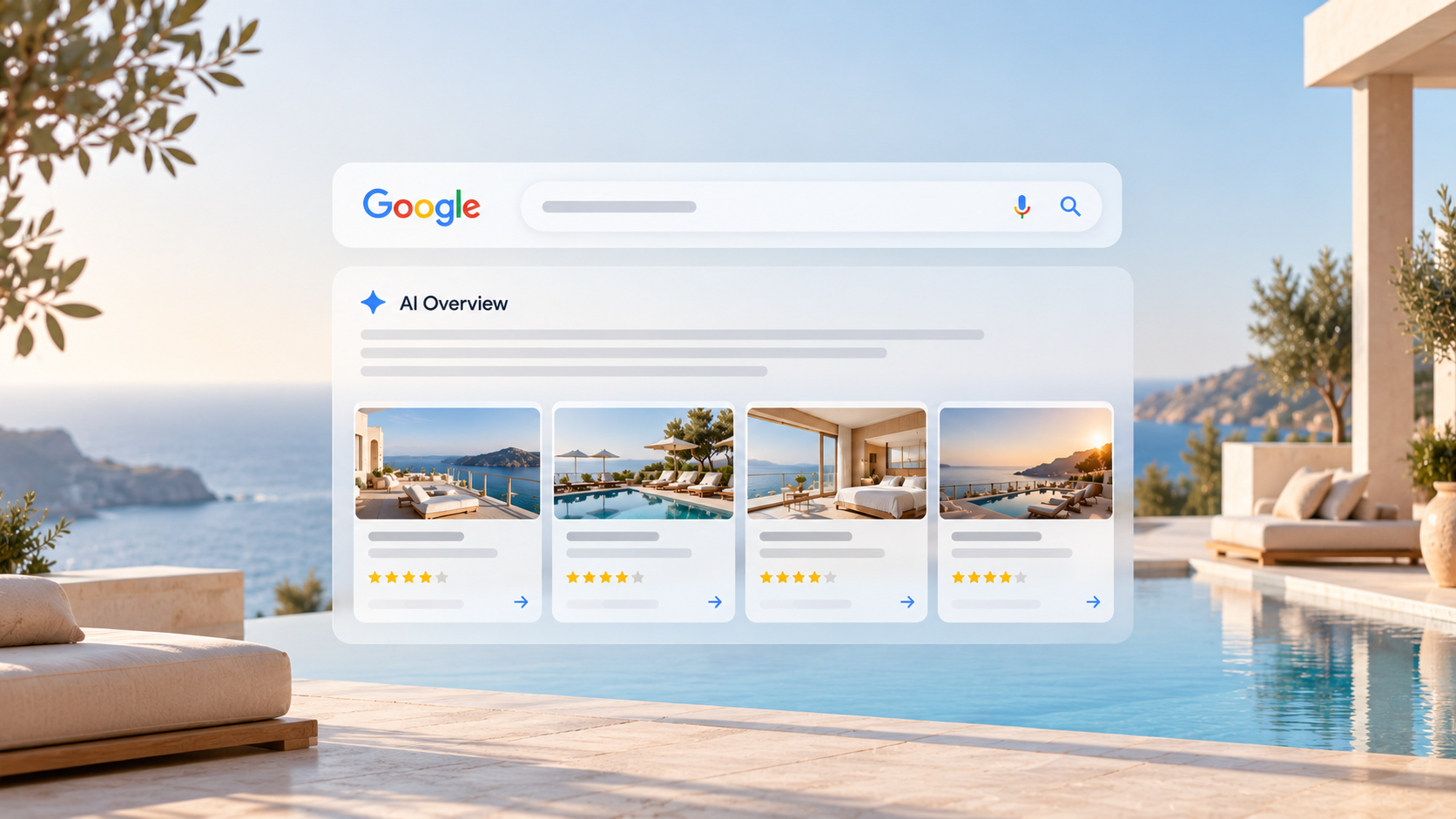
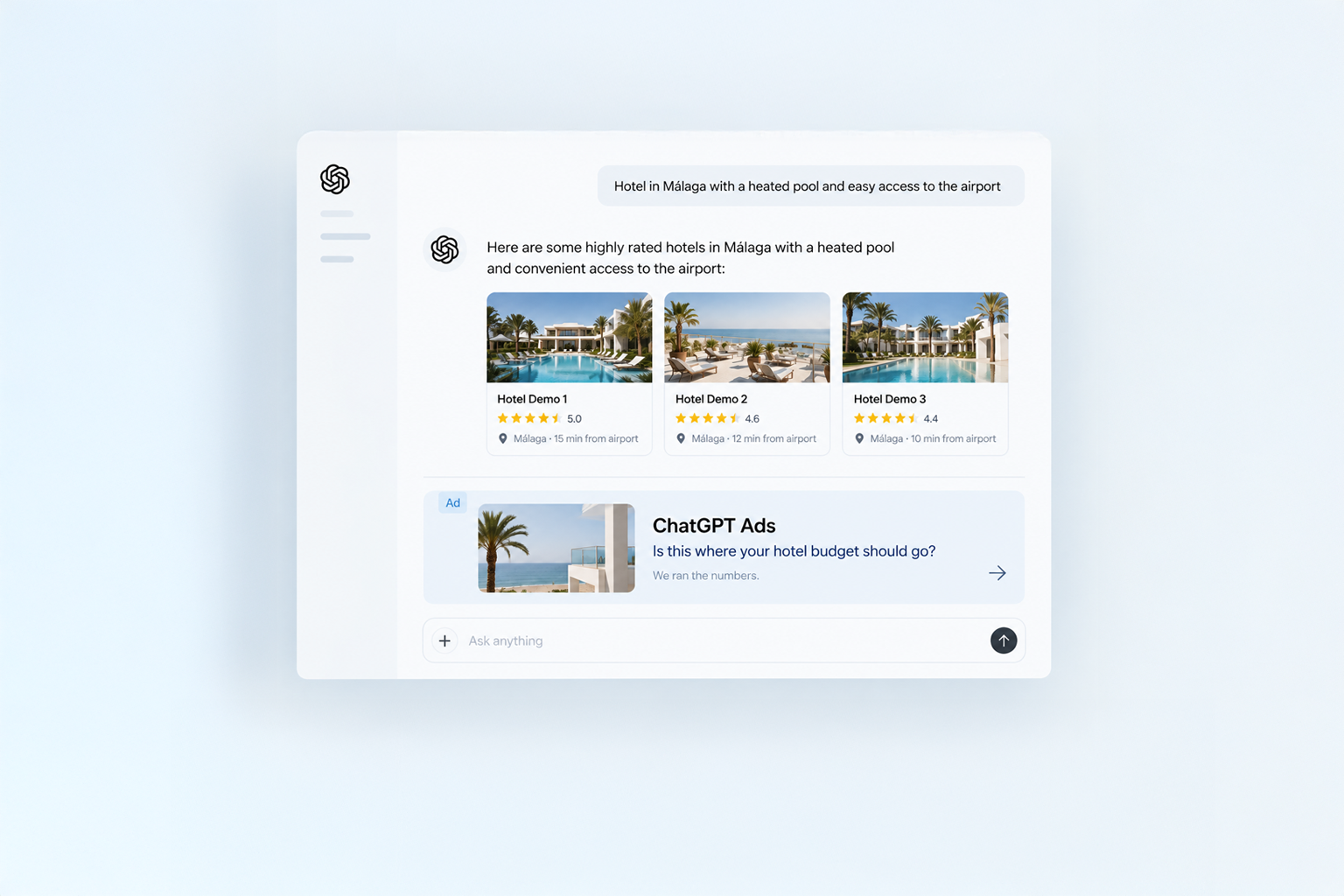
More and more searches like "Black Friday in X destination" are answered by a generative search engine. These systems tend to show whoever has a stable presence worked on over time, not whoever improvises a landing page in the middle of November.
In that context, maintaining a consistent digital presence and clear, useful, up-to-date information can help a hotel be easier to find and understand for AI.
A well-crafted landing page, connected to the rest of the website and updated each season, is part of that strategy. It doesn't guarantee appearing in AI answers, but it does avoid depending on an improvised page when the campaign is about to start.
Black Friday is the last Friday in November, which this year falls on the 27th. Cyber Monday, November 30, and Travel Tuesday, December 1. With that calendar ahead, these are the decisions that, from experience, are worth closing first.
If you're reading this article with the campaign already upon you, don't stop. There's still time to review the priority points. Start with the ones that can directly affect conversion and leave the secondary tweaks for later.
What defines a campaign isn't the percentage, it's the booking conditions. The setup that performs best combines five pieces.
The most undervalued piece of this puzzle is usually the travel window. Extending it to the end of 2027 can help capture bookings well in advance and strengthen lower-demand periods. The key is to adjust the dates to the destination's seasonality and the hotel's real needs.
Before the campaign, it's worth reviewing your booking engine's features. There may be options you're not yet taking advantage of: an exclusive pre-sale for club members, stackable discounts or additional benefits that add value without compromising the margin.
The pre-sale for loyalty members is a good example. Giving them early access turns Black Friday into an opportunity to drive sign-ups and strengthen the relationship with your regular guests. Beyond generating bookings before the general campaign, you can grow your database for future commercial actions.
The newsletter and your customer database are two key resources to activate demand without relying solely on paid acquisition. That's why the campaign should be communicated through these channels well in advance. Afterward, social media and retargeting actions can help widen the reach and win back the interest of those who haven't booked yet.
On mobile, the message has to be understood at a glance. Prioritize creatives designed for small screens, a discount that's easy to spot and a booking button visible without having to scroll. If you add a pop-up, make sure it doesn't get in the way of navigation and that the option to close it is clear.
The Black Friday landing page can stay active all year. What's worth preparing in advance is its campaign version: the final offer, copy, creatives and rate setup.
Whenever possible, set aside about six weeks to coordinate design, layout, support and technical setup. Each step takes its time and working with margin lets you review the details before publishing. If the campaign is close, prioritize the essentials to get the offer live and leave the secondary tweaks for the end, without neglecting the booking experience.
Black Friday, Cyber Monday and Travel Tuesday can work as a sequence of connected promotions. When one offer ends, check where its landing page points: if there's another active campaign, you can direct the user to it so they find a current alternative instead of landing on an outdated page.
Sending the first message isn't always enough. A well-planned reminder can win back the attention of those who haven't booked yet, especially when the campaign runs across several days.
Schedule follow-up sends based on user behavior and avoid repeating the same message without purpose. Recall the offer conditions, highlight its deadline when there is one and make direct access to the booking engine easy.
Four mistakes that go unnoticed until the campaign is already over.
A Black Friday campaign doesn't come down to a single decision. Price matters, but so do your booking engine setup, loyalty, payments, promotion and the ability to handle every sales opportunity.
To help you check whether you have every front covered, we've built a calculator of your Black Friday readiness. In under a minute, you can assess eight key areas of your strategy and get a visual diagnosis.
The tool identifies what you have ready, what's worth strengthening and what's still pending. It also gives you specific recommendations for each area, with a roadmap to prioritize improvements before the campaign starts.
Even with that weight, many hotels end up making the decisions that matter at the last minute. We're not here to convince you that Black Friday matters, you already know that. We want to help you lay out the steps in a phased plan so that, when the sales week arrives, all you have to do is launch the campaign.
~7%
of annual direct sales, in a single week
×3
the campaign grew in 2024 versus the previous year
+7%
grew again in 2025 versus 2024
92%
of the campaign's bookings come through the website
Prefer to get straight to it?
Calculate your hotel's Black Friday readiness in under a minute. Eight key areas and a visual diagnosis.
Black Friday isn't a day, it's a campaign
Black Friday is no longer limited to the last Friday in November. Some talk about Black Week or even Black Month. The campaign can also stretch on, continuing Monday with Cyber Monday and closing Tuesday with Travel Tuesday. For the traveler, it's one single wave of offers, not necessarily five separate moments.
For your club or your repeat guests, the window can start even earlier. A two or three-day pre-sale reserved for your members and most loyal guests gives them priority access to the offer and, along the way, turns Black Friday into one more reason to join.
The roadmap to prepare it is, broadly speaking, similar in Spain, Mexico, Colombia or Portugal. What changes from one market to another is the commercial strategy and the message, which should be adapted to each destination.
A campaign that keeps growing
Especially in the hospitality sector, Black Friday doesn't carry the same weight today as it did a few years ago, and the results of our campaigns reflect that evolution. In 2024, the result nearly tripled that of the previous year. In 2025, it grew again by 7% versus 2024.
Relative evolution of the campaign (index, 2023 = 100). Heights derived from "nearly tripled" in 2024 and "+7%" in 2025. No financial figures.
These are figures from the campaigns analyzed by Paraty Tech, pointing to an increasingly relevant opportunity for direct sales.Not all bookings come through the same channel. Around 92% come in through the website and the remaining 8% by phone. Two sales channels worth having ready before the peak.
Where the campaign's bookings come from
Split by channel · % of bookings
Web
92%
Phone
8%
What past campaigns teach us
The best price doesn't win on its own
Let's start with the most uncomfortable lesson, and also the most profitable. In more than one campaign, the hotel with the most aggressive strategy wasn't the one that performed best, and the reason wasn't the price, but the lack of communication. The discount was in the booking engine, but not in the newsletter, nor on social, nor on the website home. What the guest doesn't see, for them doesn't exist.
Bonus Tip
A good price that is poorly communicated performs worse than an average price well communicated.
A 5% isn't an offer, it's a decoration
The offers that have worked best in the campaigns analyzed have sat in a range between 20% and 40%, with well-thought-out conditions. But it isn't about announcing a percentage because the market moves at those figures, it's about offering the best price your hotel can put on the table.
The guest has a memory. They know what they paid for their seven nights in August, and if they don't find a lower rate, they won't book. That's why the discount isn't a figure chosen on paper: it's calculated from the reference price for those dates and the promotional rate you can offer for 2027. The percentage you communicate comes out of that difference.
How your real discount is calculated
Reference price
for those dates
−
Promotional rate
you offer for 2027
=
Your real discount
the % you communicate
Offer discount percentages, not financial results.
Price is still king. But when the margin doesn't allow going lower, there are other levers that can reinforce the offer: a package, the spa, dining, a late check-out, an upgrade or parking included. These extras raise perceived value at a controlled cost, but they work better as a complement than as a substitute for a good price.The landing page that lasts for years
The Black Friday landing page can keep working even after the campaign ends. That's why it's usually better to use a permanent URL, like /black-friday.html, instead of creating a new one every year, like /black-friday-2026.html.
/black-friday.html · Permanent URL, reused every November and keeps the SEO signals it has built up.
/black-friday-2026.html · New URL every year, splits the signals across different addresses.
A good practice is to keep it active all year, with content adapted to each phase, and to link to it from other relevant pages of the website.
AI visibility is also built over time
More and more searches like "Black Friday in X destination" are answered by a generative search engine. These systems tend to show whoever has a stable presence worked on over time, not whoever improvises a landing page in the middle of November.
In that context, maintaining a consistent digital presence and clear, useful, up-to-date information can help a hotel be easier to find and understand for AI.
A well-crafted landing page, connected to the rest of the website and updated each season, is part of that strategy. It doesn't guarantee appearing in AI answers, but it does avoid depending on an improvised page when the campaign is about to start.
The keys to preparing your Black Friday campaign
Black Friday is the last Friday in November, which this year falls on the 27th. Cyber Monday, November 30, and Travel Tuesday, December 1. With that calendar ahead, these are the decisions that, from experience, are worth closing first.
If you're reading this article with the campaign already upon you, don't stop. There's still time to review the priority points. Start with the ones that can directly affect conversion and leave the secondary tweaks for later.
The offer is configured, not just discounted
What defines a campaign isn't the percentage, it's the booking conditions. The setup that performs best combines five pieces.
| Piece | How to set it up |
|---|---|
| Booking window | Limited to the campaign days, to concentrate demand. |
| Travel window | Long, until the end of the following year, turning the campaign into a sales cushion for 2027. |
| Discount | Visible and credible, between 20% and 40%, or an equivalent value extra. |
| Rates | Non-refundable with the club rate stackable on top, never instead of the offer. |
| Prepayment | Moderate, protecting the sale without slowing conversion. |
Your booking engine can offer more
Before the campaign, it's worth reviewing your booking engine's features. There may be options you're not yet taking advantage of: an exclusive pre-sale for club members, stackable discounts or additional benefits that add value without compromising the margin.
The pre-sale for loyalty members is a good example. Giving them early access turns Black Friday into an opportunity to drive sign-ups and strengthen the relationship with your regular guests. Beyond generating bookings before the general campaign, you can grow your database for future commercial actions.
Newsletter, social and retargeting: activate your channels
The newsletter and your customer database are two key resources to activate demand without relying solely on paid acquisition. That's why the campaign should be communicated through these channels well in advance. Afterward, social media and retargeting actions can help widen the reach and win back the interest of those who haven't booked yet.
On mobile, the message has to be understood at a glance. Prioritize creatives designed for small screens, a discount that's easy to spot and a booking button visible without having to scroll. If you add a pop-up, make sure it doesn't get in the way of navigation and that the option to close it is clear.
The logistics are decided beforehand
The Black Friday landing page can stay active all year. What's worth preparing in advance is its campaign version: the final offer, copy, creatives and rate setup.
The three campaigns chain each landing page
Black Friday, Cyber Monday and Travel Tuesday can work as a sequence of connected promotions. When one offer ends, check where its landing page points: if there's another active campaign, you can direct the user to it so they find a current alternative instead of landing on an outdated page.
Reminding is a core part of the campaign
Sending the first message isn't always enough. A well-planned reminder can win back the attention of those who haven't booked yet, especially when the campaign runs across several days.
Schedule follow-up sends based on user behavior and avoid repeating the same message without purpose. Recall the offer conditions, highlight its deadline when there is one and make direct access to the booking engine easy.
Mistakes we've seen repeated
Four mistakes that go unnoticed until the campaign is already over.
01
A promo code that hides the offer
If the discount depends on a code the user doesn't know, it can go unnoticed. Except in exclusive promotions, like a members' pre-sale, make sure the advantage is visible and easy to apply.
02
A travel window that excludes
A stay period that's too short can leave out part of future demand. Review how far out it makes sense to let someone travel when they book during the campaign.
03
Restrictions that suffocate
Too many blocked dates, a high minimum stay or inflexible conditions can make an attractive offer hard to use.
04
A disparity that breaks the price
Before and during the campaign, check that the prices and conditions on your official website stay competitive against other distribution channels. Promoting direct sales isn't enough if the proposition loses appeal when compared.
Is your hotel ready for Black Friday? Find out
A Black Friday campaign doesn't come down to a single decision. Price matters, but so do your booking engine setup, loyalty, payments, promotion and the ability to handle every sales opportunity.
To help you check whether you have every front covered, we've built a calculator of your Black Friday readiness. In under a minute, you can assess eight key areas of your strategy and get a visual diagnosis.
The tool identifies what you have ready, what's worth strengthening and what's still pending. It also gives you specific recommendations for each area, with a roadmap to prioritize improvements before the campaign starts.
Is everything ready for Black Friday?
Find out and discover where you have room to improve.
Calculate my readiness level