No-show payment collection starts with rate design
Booking Engine 19/10/2026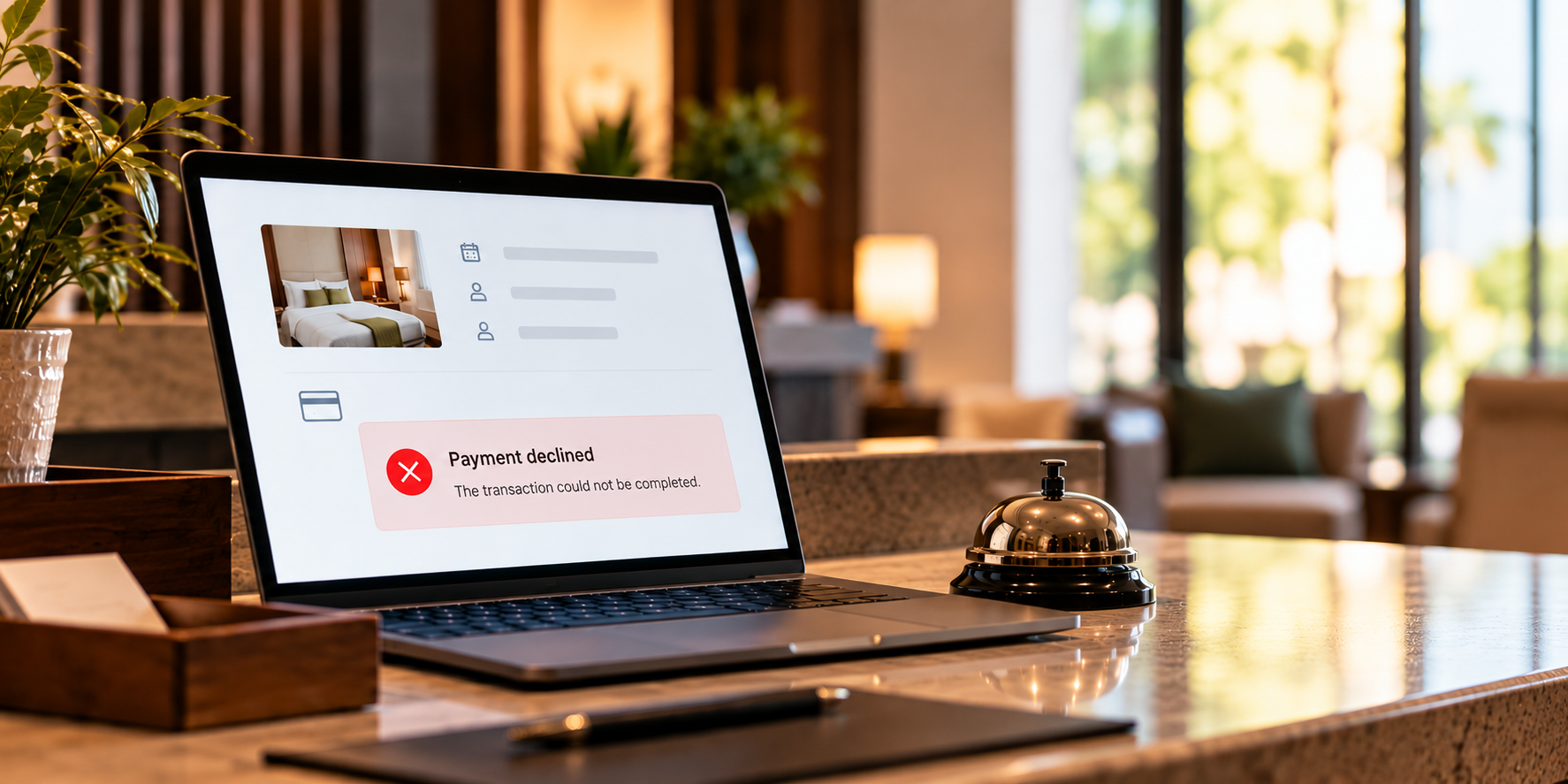
Tuesday, 11:00 a.m. The front desk runs the charge for yesterday's no-show. The payment gateway declines it. That reservation is now a case that will bring you zero revenue and plenty of headaches.
A booking can look guaranteed OTB until it turns into a no-show and the time comes to charge the penalty. You have the card, the details are stored, but… what happens if the bank declines the charge?
The problem isn't necessarily the card. Sometimes the difference comes down to how the payment conditions were set up and what measures are in place for when something goes wrong.
The thing is, after the fact there isn't always a fix. It's anticipation and planning ahead that give you room to maneuver.
Scenarios that repeat over and over
At Paraty Tech, we've identified some of the situations that come up most often among the hotels we work with:
- The charge fails and no one notices. The transaction was declined. The card is invalid, had expired, lacked sufficient funds, or the issuer rejected the transaction before the arrival date, and no one realized until the no-show came to light.
- The non-refundable rate is still unpaid. The rate offered the option to pay later, but that payment never arrived and no one followed up in time.
In both cases, anticipation is key: catching issues early and having a defined procedure to resolve them keeps a payment problem from ending in non-payment.
Every uncharged no-show costs you three times over
- First, the night tied to the no-show. That room could have been resold to a guest who would have actually shown up.
- Second, the time spent sorting out the problem. Retrying charges, emailing the guest, opening the case, reconciling the billing. Those are hours of work, and they cost money.
- Third, and this matters most, the credibility of the rate. If the penalty is never charged, the non-refundable rate stops being non-refundable. The guest learns that nothing happens if they don't show up, and the discount you gave in exchange for the guarantee comes to nothing.
A stored card doesn't guarantee payment
For years, storing a card worked as a guarantee. If the guest didn't show, the hotel charged. Period.
In Europe, that changed with Strong Customer Authentication (SCA) under PSD2, in force since September 2019. A word of caution: not every later charge necessarily requires re-authentication, nor is a stored card declined by default. What really matters is what is communicated at the time of booking, how it's communicated, and what was agreed then.
If the guest authorized future charges, the hotel can collect them without asking for anything else. The bank has the final say, but the odds are in your favor. If, instead, only the details were stored, the bank may request additional authentication. And the guest who didn't show up won't be there to complete it either.
Outside Europe the rules change, but the outcome not so much: virtual cards loaded with just enough, daily limits, banks that block international charges…
A detail stored in the system is just a number. It doesn't guarantee payment.
The guarantee begins when you design the rate
The most useful rule is also the simplest: whatever you want to charge, charge it or secure it while the guest is still in front of the screen.
At that moment they have the card in hand, their phone ready to authenticate, and every intention of booking. If the payment fails right then, they can try another card. A week later, everything has cooled off and none of that is guaranteed.
A cancellation policy with no collection mechanism behind it is a promise. And promises don't pay for rooms. Every rate needs its own, plus a plan B in case it fails.
| Rate type | What to weigh | If the charge fails |
|---|---|---|
| Non-refundable | Charge the full amount at booking | If there's deferred payment, a payment link with a deadline and automatic cancellation if it isn't completed |
| Flexible with penalty | Deposit or a later charge authorized by the guest | Immediate notice to the guest and the team, with time to resolve it |
| Flexible without penalty | A guarantee in line with your commercial policy | Follow-up before arrival on high-occupancy dates, with no charges the rate doesn't provide for |
| Groups and long stays | A payment schedule and staged deposits | Agreed protocol and deadline control |
With non-refundable rates, tell paid bookings apart from pending ones. Even with the same commercial conditions, the risk is very different.
Put every rate to the test: what exactly happens if the charge fails? If the answer is "we cancel it at no cost," that rate isn't protected.
The moment a payment fails, the clock starts ticking
A scheduled charge that fails silently is worse than no charge at all. That's why a declined charge shouldn't be discovered on the day of arrival.
Make sure you define a clear, detailed protocol: who gets the alert, when the guest is informed, what payment alternatives they're offered, and how long they have to settle it.
Has the no-show already happened and the charge been declined? Retrying blindly rarely works. If the conditions allow, contact the guest, send them a payment link, and keep a record of what they agreed to and the outcome.
On top of that, log every incident and review regularly:
- What share of expected charges fail.
- Which rates, markets, or payment terms account for the most issues.
- How many are resolved before arrival and how many end in non-payment.
Transparency is a form of guarantee too
State clearly and visibly, on the booking page and in the confirmation email, when the charge happens, how much, and why. A guest who knows what they agreed to disputes the charge less. Fine print is a recipe for misunderstandings and frustration.
Technology in the service of strategy
The booking engine and the payment gateway have to be fully aligned. The former applies the conditions of each rate; the latter handles processing payments according to the configuration in place.
At Paraty Tech, Paraty E-Payments is part of that process, safeguarding the connection between the engine and the platforms and gateways we're integrated with, such as Stripe, Adyen, PayPal, and Trust Payments, among many others (more than 50). That said, the available options depend on each solution and what it can be configured to do.
Trust is configured too
The success of the direct channel also rests on trusting the guest. But trusting isn't the same as improvising. Every booking that comes through your website is a guest who chose you. Losing it to a charge that fails three days later means letting slip what took so much effort to win.
A no-show can't always be prevented. What you lose to it, often can be. That's why our recommendation is clear:
Charge when it's due. Communicate when it fails.