The Best Online Price Isn't Given Away, It's Protected
Revenue 03/08/2026
Automatically matching the lowest available rate is not the same as controlling rate parity. Depending on how it's implemented, it can mean handing control over to the channel willing to undercut your price by just a little more.
In this article
- Why automatically matching every lower rate is risky
- OTAs don't sacrifice commission, they sacrifice margin
- The key: business rules
- The Parity Triangle
- What happens during a real search
We're very familiar with the concept behind this functionality. In fact, long before AI became the industry's favorite buzzword, we had already solved this challenge—and we continue to do so—with Parity Maker.
That said, we believe this announcement provides the perfect opportunity to discuss a broader issue. The success of a solution like this lies in the details. Execution is everything, and depending on how it's configured, what appears to be an advantage can quickly become a double-edged sword. Ours, by the way, is a very sharp tool, and here's why it continues to deliver such strong results.
Automatically matching every lower rate comes with risks
Let's make one thing clear from the outset: a Best Rate Guarantee should, above all, protect your authority over your pricing strategy—not hand it over to someone else. If you automatically match the lowest rate, regardless of where it comes from, your direct pricing is effectively being dictated by whichever intermediary is willing to discount a little more. That's not rate parity management. That's giving away control when your goal is to drive direct bookings.
The logic is simple. A lower rate than yours can appear for countless reasons: an OTA reducing its own margin (the most common scenario), a leaked wholesaler rate, a misconfigured promotion, or a distribution channel with outdated pricing. None of these situations should define—or become—your pricing strategy.
There's another consequence, too. OTAs know exactly what they're doing. If they know you'll always match their price, they also know that lowering theirs automatically lowers yours. Meanwhile, your potential guest learns that it pays to keep searching before booking. Those are two unhealthy behaviors you may be encouraging without realizing it. Your pricing authority is an asset, and once you lose it, it's difficult to regain.
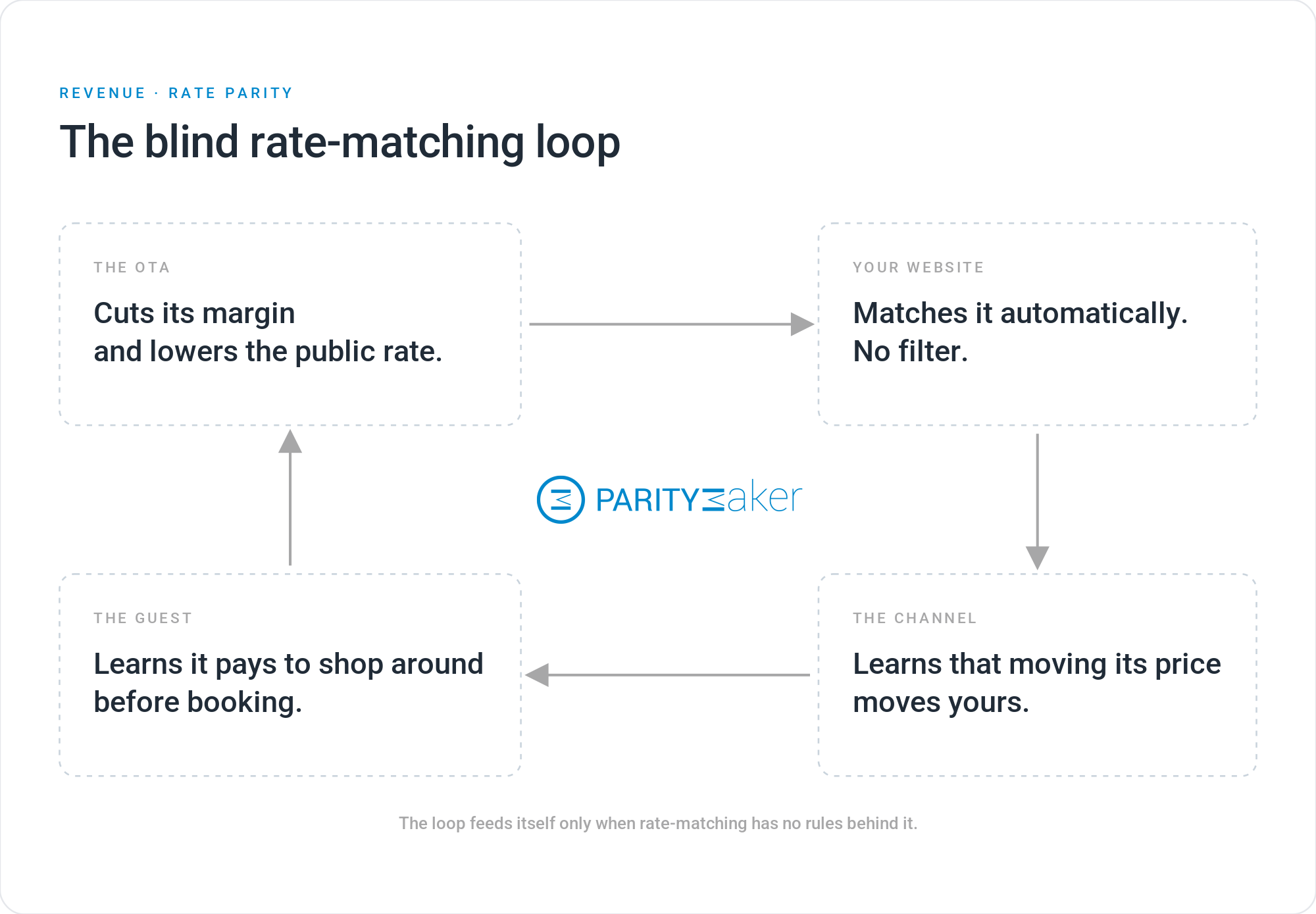
Whose pocket does the discount come from?
Two identical discounts
The OTA lowers its selling price
- Commission charged to your hotel: unchanged
- Its margin: reduced
You blindly match the rate
- Commission you pay: unchanged
- Your margin: reduced
Same discount. Different pocket.
OTAs don't sacrifice commission, they sacrifice margin
When an OTA displays a lower price, it isn't giving up its commission—it is giving up part of its own profit. Your hotel still pays exactly the same commission. The OTA simply gives up a portion of its margin to win the booking. Along with the payment. And the guest relationship.
Are you really willing to give up your own margin just to match a discount funded by someone else's pocket—someone with greater financial resources and a much longer-term strategy? The real question isn't whether you should lower your rate, but when, by how much, and under what conditions it actually makes business sense.
The key: business rules
This is where everything changes. A tool that blindly matches lower rates is like a carnival shooting gallery: you might hit the target with your first two shots, but you'll almost certainly miss the third—the one that actually wins you the prize. What you need isn't the accuracy of a carnival game, but the precision of a surgeon's scalpel.
We've been putting that scalpel in hoteliers' hands for years. It's called Parity Maker, our real-time rate-matching solution, and it remains a capability few hotel technology providers can offer. Its strength isn't simply matching rates—it's giving you complete control over how it does so:
- Choose the OTA you want to benchmark against.
- Define your own business rule.
- When a rate disparity matches your criteria, the tool takes action automatically.
- It can match the rate, undercut it by a percentage or a fixed amount, and more.
- It informs the guest in real time, improving conversion and reducing booking abandonment.
In short, you retain complete control over your pricing while protecting your margins, instead of handing that control over to whichever channel is willing to discount the most.

The Parity Triangle
Parity Maker doesn't work alone. It's part of what we call the Parity Triangle, alongside Rate Check and Price Seeker AInsights.
Rate Check is a price comparison tool integrated directly into your official booking engine. Whenever OTAs display higher prices than your direct channel for the same search criteria, it shows those rates to the guest. If an OTA is undercutting your direct rate, however, it simply isn't displayed. Showing higher OTA prices builds transparency and trust, while hiding the ones that put you at a disadvantage protects your pricing strategy. All without forcing guests to leave your website to compare rates.
Price Seeker AInsights completes the triangle with market intelligence. It monitors competitors, rate parity, and pricing trends, giving you the data you need to make informed decisions instead of relying on intuition.
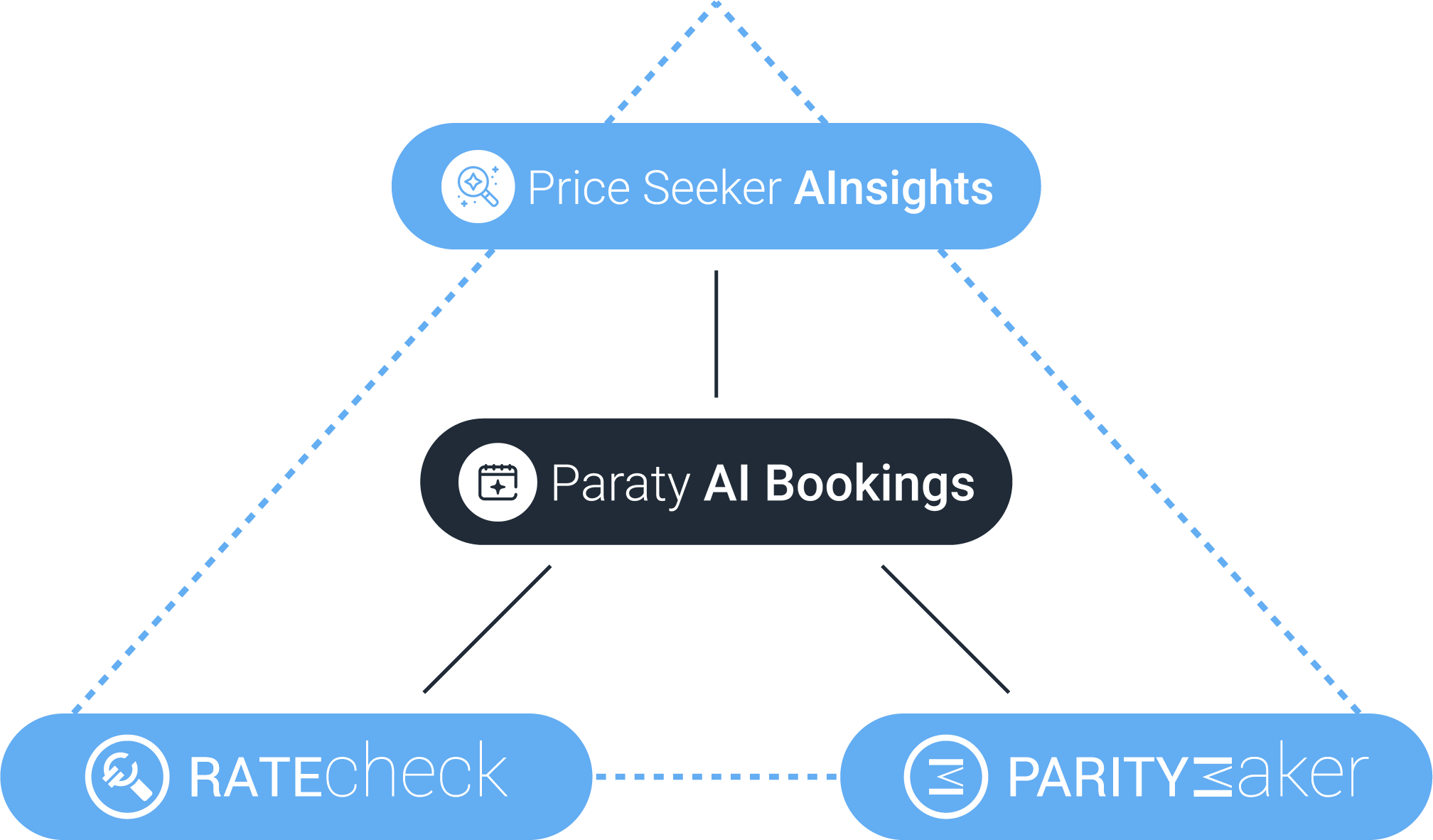
One thing ties all three solutions together: beyond their many other capabilities, they all act as early-warning systems for rate disparities.
- Parity Maker applies the business rule you've configured.
- Rate Check hides the OTA price from the comparison and alerts your revenue team.
- Price Seeker AInsights, naturally, excels at detecting and monitoring parity issues.
What happens during a real search?
A traveler searches for a stay for two adults from August 1 to August 8. At that exact moment, Price Seeker performs the same search across the OTAs you've selected. Depending on which channel offers the best available rate, either Rate Check or Parity Maker takes over.

Guaranteeing the best rate isn't giving in—it's how you drive more direct bookings
Offering the best available rate on your official website remains one of the strongest drivers of direct bookings. It builds guest confidence, reduces abandonment, and reinforces your website as your primary sales channel. In many cases, the perception of getting the best price is exactly what convinces a guest to book direct instead of through an OTA. But guaranteeing the best rate doesn't mean surrendering to the lowest—or the most aggressive—price in the market.
When an intermediary slashes its prices, if matching that rate means compromising your pricing strategy, the answer is not to follow its lead. The right response is to identify the source of the disparity, enforce your commercial agreements, and, if necessary, reassess your relationship with that distribution partner—or even suspend sales through that channel if the issue becomes recurring. Anything else—matching rates simply for the sake of matching them—means allowing the most aggressive player to dictate your pricing strategy.
Technology exists to execute your strategy with precision, not to replace it. Guaranteeing the best online rate through smart business rules isn't a race to the bottom. It's how you protect your margins while winning more direct bookings. And that's something you never had to wait for AI to achieve.